
 nl
nl de
de

Your cart is empty
Looks like you haven't made your choice yet
Nettles (allo) are used in many of our backpacks. Before allo can be used in our product, it is first processed by hand in small villages in the mountains of Nepal. The production of allo is a rich indigenous tradition that has been carried out by the local population for centuries. The bark of allo is used for a variety of woven products, namely clothing, bags, sacks, tablecloths, blankets, etc. Today, the processing of allo provides work for many Nepalese people and also for the makers of our backpacks. Allo is a good example of traditional Nepalese craft in the modern eco-friendly textile market.
Allo is extracted from the Allo Susni plant, but because the plant grows between 900 and 2500 meters above sea level, most areas are difficult to access for harvesting. It takes a few days to travel on foot to the forest, harvest Allo, and return with a load of Allo bark. The logs are left to dry for a few days after harvesting and then it is peeled off. Peeling removes the outer bark and leaves the inner bark intact for further processing.
Spinning is done either using a wooden hand spindle called Katuwa or a spinning wheel called “Charkha”.
The next step involves boiling the inner bark in a vessel with wooden ash to lighten and soften the fibers. This takes about 2-3 hours. After boiling, a repetitive process of beating the bark in water with a wooden mallet to loosen the fibers follows, this is usually done in a stream or river. The bundles of clean fibres are now laid out in the sun to dry. Once done, it is further soaked in water and mixed with ground corn (most common in western Nepal), or Kamero (locally available white clay with mica) to get a nice white sheen. Finally, the fibres are extracted using simple household items such as tongs and, once soft, it is spun into yarn.
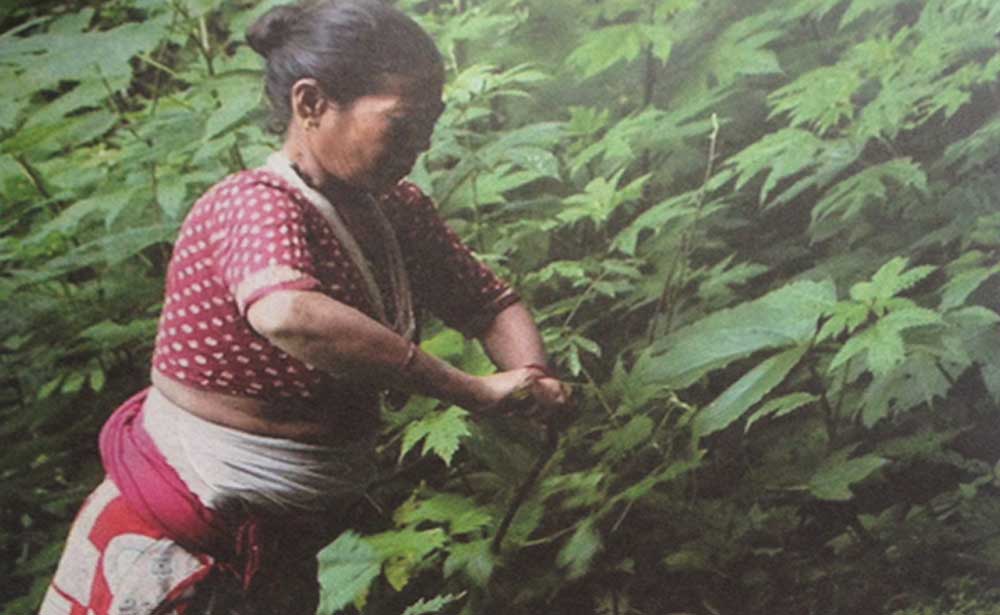
Mainly women are involved in all stages of collecting and processing Allo. Spinning is done either with the help of a wooden hand spindle called Katuwa or a spinning wheel called “Charkha”. Charkha has two variants: The hand-operated “haate” or the foot-operated “khutte”. The process of spinning the fibres by hand is a monotonous activity and can take a very long time. Fortunately, more and more electric machines are being used in areas where electricity is available. The productivity of micro-enterprises can be greatly increased in this way.
We do our best to get your package to you as quickly as possible. Our products are shipped every weekday and on Saturdays.
| Country | Min. days | Max. days | Ship costs | Free from |
|---|---|---|---|---|
| NL | 1 | 2 | €5 | €75 |
| West EU | 2 | 5 | €10 | €100 |
| UK and Ireland | 3 | 7 | €12,50 | €125 |
| Other EU countries | 5 | 10 | €15 | €150 |
| Rest of the world | 10 | 25 | €25 | €250 |
In the document below you will find a current overview of delivery times for all countries worldwide.
Comments
There are no comments yet.